When you spot a litter of feral kittens huddled in a barn, under a porch, or in a vacant lot, your heart naturally goes out to them. These tiny, vulnerable creatures seem helpless—and they are. But behind those innocent faces lies a larger issue that affects wildlife, ecosystems, and communities across the country: the rapid and unchecked reproduction of domestic cats living outdoors.
Understanding why rescuing feral kittens matters—and why spaying and neutering is absolutely critical—can help you become part of the solution to a growing environmental and animal welfare crisis.
The Reality: Cats as an Invasive Species
While we love our feline companions, it’s important to acknowledge a difficult truth: domestic cats (Felis catus) are considered an invasive species when living and breeding outdoors. They are not native to North America, and their presence in the wild has significant ecological consequences.
Impact on Wildlife
Free-roaming cats are highly efficient predators. Studies have shown that outdoor cats in the United States kill billions of birds, small mammals, reptiles, and amphibians each year. This predation puts enormous pressure on native wildlife populations, some of which are already threatened or endangered.
Key impacts include:
- Bird populations: Cats kill an estimated 1.3 to 4 billion birds annually in the U.S. alone
- Small mammals: 6.3 to 22.3 billion mammals (mice, voles, chipmunks, rabbits) are killed by cats each year
- Reptiles and amphibians: Lizards, snakes, frogs, and other species face significant predation
- Ecosystem disruption: The loss of these animals disrupts food chains and ecosystem balance
Unlike native predators that hunt for survival, well-fed outdoor cats still hunt due to instinct, meaning their impact isn’t limited by hunger. Even a single outdoor cat can significantly affect local wildlife populations.
The Difference Between Pet Cats and Feral Colonies
It’s important to distinguish between:
- Pet cats allowed outdoors: These cats have homes but are allowed to roam, contributing to wildlife predation
- Feral and stray cats: These cats have no owners and live entirely outdoors, reproducing unchecked and creating colonies that expand rapidly
Both contribute to the invasive species problem, but feral colonies represent a particularly urgent challenge because of their rapid reproduction rates.
The Mathematics of Cat Reproduction: A Population Explosion
One of the most shocking aspects of the feral cat crisis is how quickly populations can spiral out of control. The reproductive capacity of cats is staggering and often underestimated.
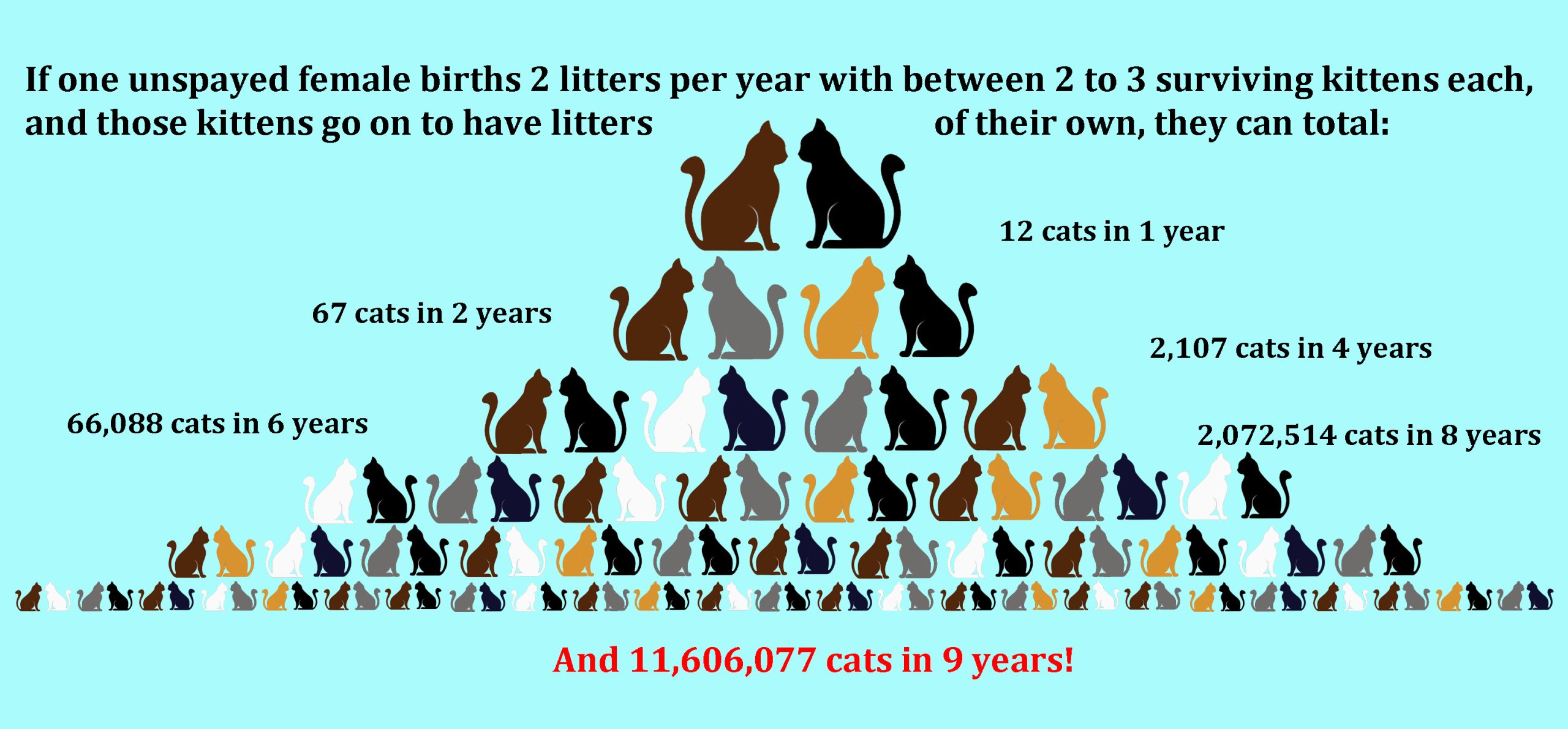
The Numbers Don’t Lie
A female cat can:
- Enter her first heat cycle as young as 4 MONTHS old
- Have 2-3 litters per year
- Produce 4-6 kittens per litter
- Result in up to 50 kittens in just one year from a single unspayed female
But it gets exponentially worse:
- Those kittens can begin reproducing at 4 months old themselves
- Within 7 years, one unspayed female cat and her offspring can theoretically produce 370,000 cats
Real-World Colony Growth
While not every kitten survives to reproduce, real-world studies confirm rapid population growth:
- Unmanaged feral colonies can increase by 47% in just two years
- A colony starting with just 5 cats can grow to 50+ cats within 3 years without intervention
- Urban and suburban areas can quickly become overwhelmed with hundreds of cats
This exponential growth creates:
- Increased wildlife predation
- Public health concerns (disease transmission)
- Animal welfare issues (starvation, illness, injury among cats)
- Community conflicts and complaints
- Overwhelmed animal shelters
Why Rescuing Feral Kittens Matters
Feral kittens represent both a challenge and an opportunity. Here’s why early intervention is crucial:
The Socialization Window
Kittens have a critical socialization period between 2-8 weeks of age. During this time, they can learn to trust humans and become adoptable pets. After about 8-12 weeks, kittens become increasingly difficult to socialize and may remain feral for life.
Benefits of early rescue:
- Kittens can be socialized and adopted into homes
- They’re removed from the breeding population
- They won’t contribute to wildlife predation
- They’ll live longer, healthier lives as indoor pets
- Each rescued kitten prevents potentially thousands of future feral cats
Health and Welfare Concerns
Feral kittens face tremendous challenges:
- High mortality rates (50-75% die before reaching adulthood)
- Exposure to diseases, parasites, and harsh weather
- Vehicle strikes and predator attacks
- Malnutrition and starvation
- Injuries from fights and accidents
Rescuing these kittens gives them a chance at a safe, healthy life while addressing the larger population problem.
Breaking the Cycle
Every feral kitten rescued and spayed/neutered is one less cat contributing to:
- Uncontrolled population growth
- Wildlife decimation
- The burden on animal shelters
- Community cat problems
This is why rescue efforts must always include spaying and neutering—it’s the only way to truly solve the problem rather than temporarily managing symptoms.
The Critical Importance of Spaying and Neutering
If there’s one takeaway from understanding the feral cat crisis, it’s this: spaying and neutering is the ONLY effective long-term solution.
Why Spay/Neuter Works
Immediate effects:
- Instantly stops reproduction in treated cats
- Prevents new litters from entering the population
- Stabilizes colony sizes
Long-term impacts:
- Managed colonies decline by 30-66% over several years
- No new kittens means no new feral cats
- Wildlife predation decreases as populations shrink
- Community complaints and conflicts reduce
Health benefits for cats:
- Eliminates risk of reproductive cancers
- Reduces fighting and injury (especially in males)
- Decreases roaming and risk behaviors
- Often results in weight gain and improved coat condition
- Reduces mating behaviors like yowling and spraying
Trap-Neuter-Return (TNR): The Proven Solution
TNR is the most humane and effective method for managing feral cat populations:
The Process:
- Humanely trap feral cats and kittens
- Take them to a veterinarian for spaying/neutering and vaccination
- Ear-tip the cat (a universal sign they’ve been sterilized)
- Return adult feral cats to their territory
- Remove and socialize young kittens for adoption
Why TNR Works:
- Studies show 36-66% population reductions in managed colonies
- Prevents the “vacuum effect” (when removed cats are replaced by new ones)
- Improves cat health and reduces nuisance behaviors
- More cost-effective than catch-and-kill approaches
- Community-supported and sustainable
What happens without TNR:
- Populations continue to explode
- Animal control resources are overwhelmed
- Cats are euthanized but quickly replaced
- Wildlife continues to suffer
- The cycle never ends
How to Rescue Feral Kittens: A Step-by-Step Guide
If you’ve found feral kittens, here’s how to help them effectively and safely:
Step 1: Assess the Situation
Determine if rescue is needed:
- Are the kittens truly orphaned? (Watch from a distance for 4-6 hours to see if mother returns)
- How old are they? (Eyes closed = under 2 weeks; eyes open but wobbly = 2-4 weeks; running around = 4+ weeks)
- Are they in immediate danger?
Important: If kittens appear healthy and mother is present, TNR of the mother (once kittens are weaned) may be the best approach.
Step 2: Prepare for Rescue
Gather supplies:
- Humane trap or carrier with secure door
- Thick gloves (feral kittens can scratch and bite)
- Towels or blankets
- Small, quiet room for isolation
- Kitten food, litter box, water
Safety first:
- Feral kittens can carry diseases
- Wear protective clothing
- Keep them isolated from your pets initially
Step 3: Capture Safely
For very young kittens (under 4 weeks):
- You may be able to pick them up by hand (wear gloves)
- Move quickly and confidently
- Place immediately in secure carrier
For older kittens (4+ weeks):
- May require a humane trap
- Use smelly food (tuna, sardines) as bait
- Be patient—it may take time
- Never chase or corner kittens (causes extreme stress)
Step 4: Immediate Care
First actions:
- Place in quiet, warm space away from household pets
- Provide food, water, and litter box
- Check for obvious injuries or illness
- Do not attempt to handle excessively at first
Veterinary care:
- Schedule vet visit within 24-48 hours
- Get deworming, flea treatment, and health check
- Test for FeLV/FIV if old enough
- Begin vaccination series
- Schedule spay/neuter (usually at 8 weeks/2 pounds minimum)
Step 5: Socialization
For kittens under 8 weeks:
- Start handling gently but regularly
- Speak softly and move slowly
- Offer treats and play sessions
- Most will socialize within 2-4 weeks
For older kittens (8-12 weeks):
- Socialization is possible but takes longer
- May require weeks to months of patient work
- Some may remain semi-feral
- Consider experienced foster homes
Step 6: Spay/Neuter Before Adoption
Critical timing:
- NEVER adopt out an unaltered kitten
- Schedule surgery at 8 weeks/2 pounds minimum
- Some vets perform “pediatric spay/neuter” as early as 6-8 weeks
- Do not rely on adopters to complete this step
Why this matters:
- Prevents accidental breeding
- Many adopters don’t follow through with surgery
- Even young kittens can reproduce if not sterilized
- You’re ensuring your rescue efforts have lasting impact
Step 7: Adoption
Find responsible homes:
- Screen potential adopters carefully
- Require adoption contracts
- Charge adoption fees (shows commitment)
- Emphasize indoor-only lifestyle
- Provide post-adoption support
What About the Mother Cat?
When rescuing feral kittens, don’t forget about mom:
If mother is feral:
- Wait until kittens are weaned (usually 6-8 weeks)
- Trap mother for spay/neuter through TNR
- Return her to her territory
- This prevents future litters
If mother is friendly:
- She may be a stray, not feral
- Rescue her along with kittens
- Get her spayed
- She may be adoptable too
Never separate too early:
- Kittens need mother’s milk and care for at least 4-5 weeks
- Early separation reduces survival chances
- Plan TNR of mother while kittens are still nursing
Addressing Common Concerns
“But cats have been outdoors forever!”
While cats have lived alongside humans for thousands of years, the scale of free-roaming cat populations today is unprecedented. Modern feral colonies with dozens or hundreds of cats didn’t exist historically, and native wildlife has never faced this level of predation pressure.
“Can’t we just leave them alone?”
Leaving feral cat populations unmanaged leads to:
- Continued exponential population growth
- Increased wildlife deaths
- More cats suffering from disease, starvation, and injury
- Greater community conflicts
- No improvement to the situation
Compassionate management through rescue and TNR is the only humane and effective solution.
“What about cats’ quality of life?”
Indoor cats live significantly longer (12-18 years) compared to outdoor cats (2-5 years on average). Indoor cats are protected from:
- Vehicle strikes
- Predators
- Disease
- Poisoning
- Extreme weather
- Human cruelty
A well-enriched indoor environment provides everything cats need for happy, healthy lives without the dangers of outdoor living.
The Role of Community Education
Solving the feral cat crisis requires more than just rescuing individual litters—it demands community-wide commitment to:
Responsible pet ownership:
- Spaying/neutering all pet cats
- Keeping cats indoors
- Microchipping and identification
- Never abandoning cats
Supporting TNR programs:
- Volunteering with local rescues
- Donating to spay/neuter programs
- Educating neighbors about TNR
- Reporting feral colonies for management
Reducing wildlife impact:
- Keeping pet cats indoors full-time
- Using bird-safe landscaping
- Supporting native wildlife conservation
- Spreading awareness about cats’ ecological impact
How AdvoCats Cat Rescue Is Making a Difference
At AdvoCats Cat Rescue, we’re committed to addressing the feral cat crisis through:
Comprehensive TNR programs:
- Trapping, neutering, and returning feral adult cats
- Rescuing and socializing feral kittens
- Managing community cat colonies
- Providing ongoing care for colony cats
Education and outreach:
- Teaching the community about responsible pet ownership
- Explaining the importance of spay/neuter
- Raising awareness about cats’ environmental impact
- Connecting residents with low-cost spay/neuter resources
Rescue and adoption:
- Finding homes for socialized feral kittens
- Ensuring all adopted cats are spayed/neutered
- Supporting adopters with resources and education
- Following up to ensure cats remain indoors
How You Can Help
Whether you’ve found feral kittens or simply want to be part of the solution, here’s how to get involved:
Take immediate action:
- Report feral cat colonies to local rescue organizations
- Rescue feral kittens following proper protocols
- Never adopt out unaltered kittens
- Always spay/neuter your own cats
Support TNR efforts:
- Volunteer with TNR programs
- Donate to spay/neuter initiatives
- Foster kittens during socialization
- Advocate for TNR in your community
Spread awareness:
- Share information about cat overpopulation
- Educate friends and neighbors about keeping cats indoors
- Support legislation that promotes TNR
- Challenge myths about outdoor cats
Connect with AdvoCats:
- Contact us if you’ve found feral kittens
- Learn about our TNR programs
- Volunteer or foster
- Donate to support our spay/neuter efforts
The Path Forward: Hope Through Action
The feral cat crisis can feel overwhelming, but every action makes a difference. Every kitten rescued, every cat spayed or neutered, every person educated moves us closer to a solution.
By understanding cats’ role as an invasive species, recognizing the mathematics of reproduction, and committing to comprehensive spay/neuter efforts, we can:
- Reduce feral cat populations humanely
- Protect native wildlife
- Improve life for community cats
- Create more harmonious communities
The tiny feral kittens you find today represent both a challenge and an opportunity—a chance to break the cycle, save lives, and create lasting change.
Together, we can ensure that every cat has a chance at a safe, healthy life while protecting the wildlife and ecosystems that depend on our stewardship.
Have you found feral kittens? Need help with TNR? Contact AdvoCats Cat Rescue today.
Visit us at advocatslife.org or reach out through our social media channels.
